

Beyond the Headlines: 5 Surprising Truths Hidden in India's 2026 Economic Survey
India’s Economic Survey 2025–26 holds far more than headline growth numbers. From food prices quietly slipping into deflation and a massive undercount of urban India, to AI’s looming impact on 38 million jobs and a surprising collapse in affordable housing supply, this deep dive uncovers five counter-intuitive truths shaping India’s economic future. We also explore how a simple behavioural ‘nudge’ helped the government uncover ₹29,000+ crore in foreign assets. Whether you’re an investor, policymaker, or curious citizen, these hidden insights reveal where India’s economy is really headed beyond the headlines.
MARKET UPDATE
1/31/20264 min read
1. Introduction: Unpacking the Numbers
Official economic reports like the annual Economic Survey are often seen as dense, data-heavy documents, inaccessible to anyone but specialists. However, buried within the tables and analyses of the "Economic Survey 2025-26" are several genuinely surprising and counter-intuitive findings that challenge common assumptions about India's economy. These data points reveal powerful undercurrents shaping the country's future. This article distills the five most impactful takeaways that everyone should know, because they signal fundamental shifts that will impact everything from investment strategies to public policy for years to come.
2. Takeaway 1: Inflation Cooled So Much, Food Prices Actually Deflated
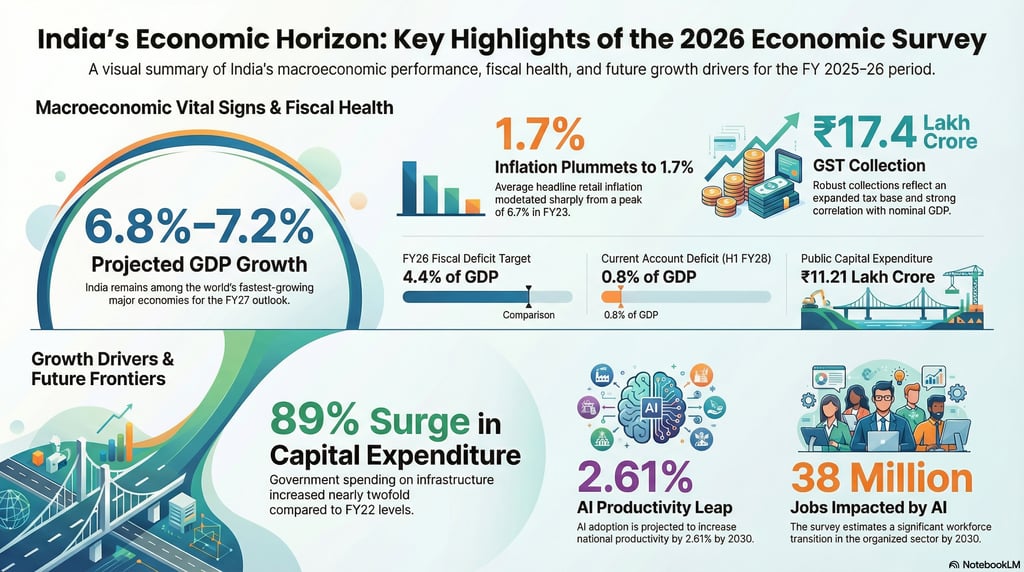
The survey presents a dramatic shift in India's inflation landscape. Average headline retail inflation dropped sharply to just 1.7% in FY26 (April–December), a significant moderation from the 6.7% recorded in FY23. However, this national average masks significant regional disparities; the survey notes that while Manipur experienced deflation, states like Kerala were still battling inflation above 8%, highlighting the uneven nature of economic relief.
The most surprising element of this national trend was in the food sector. According to the survey, food inflation not only declined but entered "deflationary territory from June 2025," meaning the average prices of food items were actually falling. This development stands in stark contrast to the global narrative of persistent inflation and, as the survey notes, was a primary contributor to lower headline inflation, directly supporting private consumption and boosting real incomes for millions.
3. Takeaway 2: Official Census Data Might Underestimate Urban India by Half
A striking data point in the survey challenges the very definition of urban India. While the official Census estimates the country's urbanization level at 31%, an alternative method reveals a vastly different picture. Using satellite data, the UN's DEGURBA method estimated that India's urban population was as high as 63% back in 2015.
This discrepancy is more than just a statistical curiosity. It completely reframes the scale of challenges and opportunities in urban infrastructure, housing, and service delivery. The survey connects this to practical policy issues, noting that low Floor Space Index (FSI) regulations in cities force costly horizontal expansion. This recalibration of urban scale is not merely academic; it fundamentally redefines the scope of India's infrastructure deficit and the urgency of its housing challenges.
4. Takeaway 3: The Coming AI Disruption Could Impact 38 Million Jobs
The survey provides a stark, quantitative look at the looming impact of artificial intelligence. It projects that the AI transition could impact 38 million employees in the organised sector by 2030. On the flip side, it also estimates that AI adoption could raise national productivity by an impressive 2.61% over the same period.
Instead of just highlighting the numbers, the survey offers a nuanced policy recommendation. The government cautions against an AI boom driven by "excessive leverage" and instead advises prioritizing "application-driven AI innovation focused on solving real-world problems." This pragmatic approach signals a desire to build a resilient AI economy based on tangible value creation, potentially avoiding the boom-and-bust cycles seen in other speculative tech waves.
5. Takeaway 4: As Demand for Affordable Housing Soars, Its Supply Is Plummeting
The survey uncovers a critical paradox at the heart of India's real estate market. The national need for affordable housing is immense, with an estimated demand for 30 million units by 2030. However, market trends are moving in the exact opposite direction. The data reveals a shocking decline in the supply of affordable housing, with its market share plummeting from 52.4% in 2018 to just 17% in 2025.
This supply crisis is happening precisely as India discovers it may be far more urbanized than previously thought, compounding the pressure on its cities and creating a policy challenge of staggering proportions. Resolving this paradox where market dynamics actively work against a key social and economic goal is no longer just a social imperative but a core requirement for sustainable urban economic growth.
6. Takeaway 5: A Simple 'Nudge' Campaign Convinced Taxpayers to Declare Over ₹29,000 Crore in Foreign Assets
Moving beyond traditional enforcement, the survey highlights a modern, behavioral-science approach to improving tax compliance. The Income Tax Department's "Nudge Initiative" uses targeted communication to encourage voluntary compliance rather than relying solely on punitive measures.
The results of one specific campaign are remarkable. The "Foreign Asset Campaign" prompted nearly 25,000 taxpayers to revise their returns, leading to the declaration of over ₹29,000 crore in previously undisclosed foreign assets and more than ₹1,000 crore in foreign income. And this was not an isolated victory; the survey reveals that similar 'nudge' campaigns targeting incorrect tax deductions for charitable donations and housing allowances recovered over ₹2,150 crore combined, proving the scalability of this behavioral approach. This demonstrates that for developing economies, investing in behavioral science can yield a higher return on investment for tax compliance than a sole reliance on expensive traditional enforcement mechanisms.
7. Conclusion: A More Complex Reality
The Economic Survey 2025-26 demonstrates that beneath the surface of macroeconomic growth figures lies a complex, dynamic, and often surprising reality. From deflation in food prices to a housing market paradox and the quiet success of behavioral economics in tax collection, the official data reveals trends that are not always captured in daily headlines. As India moves forward, the critical question is which of these forces will dominate: the deflation-driven boost to consumers, or the immense structural pressures building in its increasingly crowded cities?
Trust
A Partnership built on Trust, Transparency, and Long-term success
Turning your aspirations into reality.
Contact
prosperaa.wealth@gmail.com
+91-8208935082
© 2025. All rights reserved.
Office No.C-3, B-Wing, 1st Floor, Bharat Bazaar, Chikalthana MIDC,
Chattrapati Sambhajinagar, MH
431006
Pune, MH
Mumbai, MH